
Build a Tolland County Former-Owner Timeline
Anchor the timeline with today's deed. Every earlier transfer earns a row only once the grantee, grantor, land description, and prior book reference all agree. Dates alone mislead. A family that reuses names, or a seller who conveyed several parcels, makes matching the land itself the safer test.
| Transfer date | Grantor to grantee | Deed type | Book/page clue |
|---|---|---|---|
| Current transfer | Prior owner to current grantee | Warranty, quitclaim, fiduciary, or other recorded form | Newest instrument cited on the parcel card |
| Earlier transfer | Earlier grantor to the prior owner | As indexed | Reference found by searching that prior owner as grantee |
| Book-era link | Name pair confirmed in the older index | As written in the volume | Historic book and page, plus map or legal description |
Treat the table as a working transcript. Keep the spelling, initials, deed type, and exact reference intact even if a portal later changes its display.
Tolland County Ownership Depth Varies by Town
No single county cutoff exists. Ownership depth varies town by town. Mansfield keeps land records back to 1702. Proprietor's Records and early Town Record Books hold the oldest end, its RECORDhub run starts at volume 122 on May 19, 1973, and 1702 through 1973 is reached through online index books. Tolland cites an ownership history from 1715, though its online land-record run starts on February 25, 1942.
| Town collection | Documented span | Route to past owners |
|---|---|---|
| Mansfield Proprietor's Records | 1702 to 1730 | Book/page search in PR1 |
| Mansfield early town books | 1702-era | RB1 and RB1A book/page route |
| Mansfield modern land records | May 19, 1973 to present | RECORDhub, with older index books for earlier years |
| Tolland land records | Since 1715; web run from February 25, 1942 | Online index and images, then clerk's older books |
| Other Tolland County towns | Town-specific | Current town clerk link, counter, older volumes, archives |
Walk Tolland County's Ownership Chain in Reverse
The reverse method follows parties instead of paging through long deed lists. It also reveals non-sale links. Family transfers, trusts, corrective deeds, survivorship claims, and estate conveyances all surface this way.
- Find the current parcel card and copy its newest owner, sale date, parcel key, and deed book/page.
- Open that instrument and write down the grantor, grantee, deed type, recording date, and full land description.
- Search the grantor as a grantee in an earlier date range. Confirm that earlier deed describes the same land.
- Repeat until the web index ends, then continue by the named book series at the clerk's counter or historical collection.
- Grantor
- The party conveying an interest.
- Grantee
- The party receiving that interest.
- Chain of title
- The ordered run of instruments connecting prior owners to the present.
- Reverse index
- An index arranged to find earlier acquisitions through grantee names.
- Quitclaim and warranty deed
- Different deed forms whose legal effect cannot be judged from the short index label alone.
Vernon's Card Gives Former Tolland County Owners a Head Start
A Vernon parcel card can offer a head start. The Thrall Road card is one example. It shows owners, consideration, dates, deed types, and references. These include a 2023 warranty deed at book 2826, page 279, and an earlier 1992 warranty deed at book 882, page 79. Treat each row as a clue rather than a full chain. To continue a name and date inquiry, the Tolland GovOS deed-index source shows the town-level search environment in action.
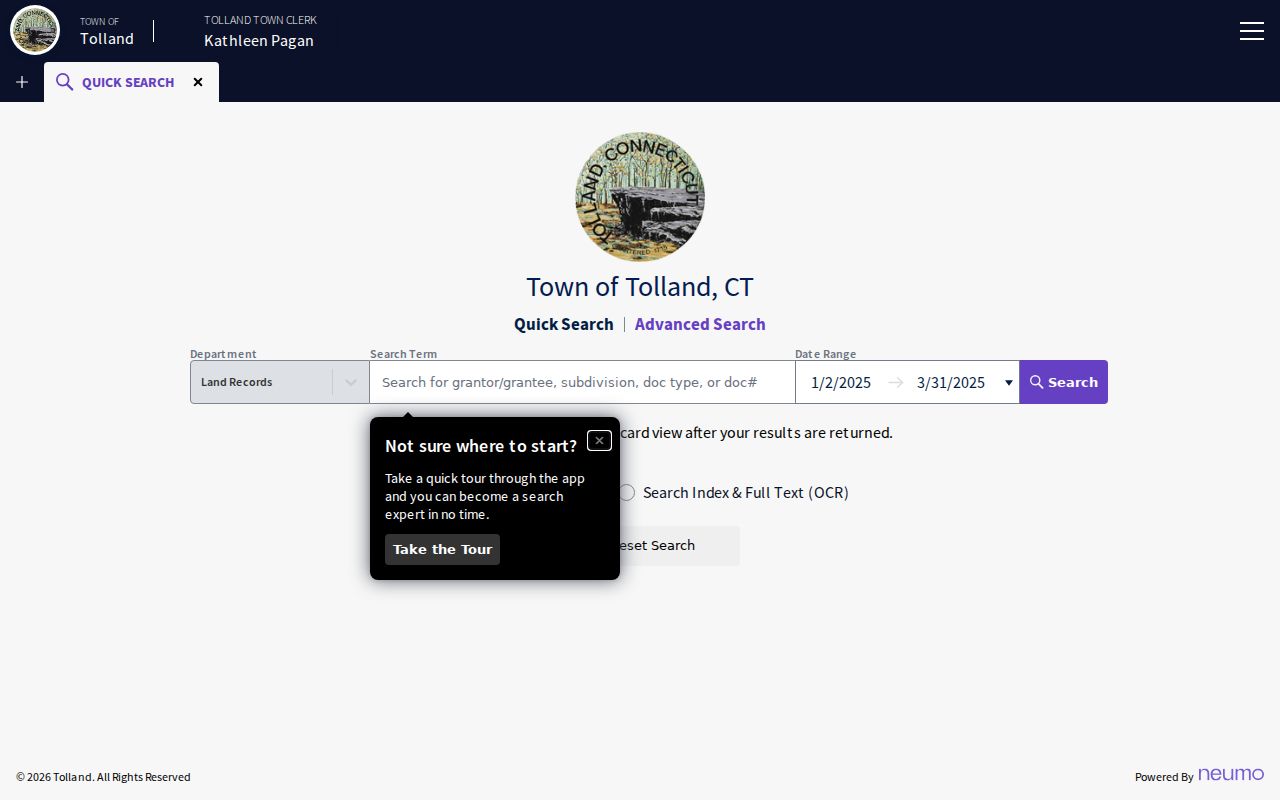
Its Quick Search and Advanced Search controls narrow a grantor or grantee by recorded date, document clue, and index or OCR scope. Filters do the sorting.
Old Map Names Recover Tolland County Previous Owners
Street labels change, and an old deed may instead name a subdivision, phase, lot, easement, or map owner. Mansfield's map index starts in 1913. Many of its map images date from 1927 forward, and its street-name index preserves Storrs Center phases, Dunham Pond Development, Dunham Farm Estates, Main Street Homes, Winswept Manor, connector streets, and FKA MAP entries.
When an address search stalls, copy the legal subdivision and map reference from the deed or assessor card. Then try historical spellings. Drop punctuation from LLC names. Reverse the spouse order and keep the lot numbers tied to their map. These habits restore continuity. A modern mailing label often cannot bridge the gap.
Probate and Nominal Transfers in Tolland County Chains
A zero-dollar deed can still anchor the chain. Probate explains many of them. A decedent's property may pass through a surviving joint owner, an executor or administrator deed, a trust conveyance, a probate order, or a family quitclaim. The assessor may keep the deceased person's name until a later Grand List refresh.
An estate can interrupt a deed sequence. Try PD25 Tolland-Mansfield. Search the Connecticut Probate Court Case Lookup by decedent, inspect the will, inventory, order, or fiduciary record that fits, then return to the town clerk for the instrument recorded against the land. A probate case explains a transition; it never replaces the land-record link.
Vaults and Archives Extend Tolland County Former-Owner Research
Ask the town clerk when the portal stops. The clerk can say which index, volume, or map book continues the run. Some scans open only by book and page. Others wait in the vault, on microfilm, or in a preservation workflow. Tolland recently rebound its grantor and grantee indexes from 1970 through 1983. It also restored roughly seventy old maps in Volume 5.
The Connecticut State Library offers town, court, census, directory, probate, and map finding aids. The State Archives adds its own aids. FamilySearch helps too. Its Connecticut town-book and microfilm sets vary, and not all names are indexed, so a catalog browse is often required. Old tax rolls, directories, newspapers, cemetery records, and the public 1790 through 1950 censuses can tie a person to an address. Only deeds establish the chain.
Resolve Gaps in a Tolland County Deed Chain
Never fill a gap with an assumption. First ask what kind of gap it is. It could be an unindexed volume, a missing web image, a portal migration, a reindexing issue, a preservation hold, a probate transfer, or a map-book reference. Connecticut's town-clerk network is also moving between legacy services and RECORDhub, so an old bookmark may no longer describe the full holdings.
A focused Freedom of Information Act request can name the town, parcel, parties, document class, and period you need. Ask to inspect first. Large series work better that way. Connecticut requires prompt public-record access subject to exemptions, though an office need not build a new chain or give a legal opinion. Log each source and date.
Separate Tolland County Former Owners From Past Occupants
A deed names a title party, not everyone who lived somewhere. Directories and census pages often list people who merely occupied an address. Those two groups overlap less than you might expect. The Connecticut State Library's directory guidance shows what a typical entry holds. Expect a name, spouse, occupation, employer, address, an owner or renter mark, and widow notations. The library's Tolland County directory holdings vary by town and year. So write down the exact volume and date whenever a librarian pulls one for you.
Directories, newspapers, cemetery files, obituaries, census pages, and probate papers can fill the gaps between deeds in a property records chain. They explain a household or an estate in ways the recorded instrument cannot. Treat them as context. Then return to the deed itself. Place any former owner of record in the chain of title only then.
How Far Back Tolland County Former Owners Can Go
Mansfield's documented sequence reaches back to 1702, and Tolland describes ownership records since 1715. Every town keeps its own creation story, indexing habits, and web cutover date. A valid chain of title stops where the town's surviving, identifiable source series stops. It does not stretch automatically to the oldest year a search screen displays. Tolland County records also carry no courthouse-fire gap. No destroyed years should be assumed when tracing deed records.
Use history with care. Former-owner research supports house history, estate work, and purchase diligence. Never use names or addresses to track, threaten, or harass a living person.
A research chain is not a certified title search. Easements, life estates, probate orders, releases, and legal-description issues may all require professional review beyond the deed index.