
Inside Tolland County Property Tax Records
Tolland County property tax records live at the town level. Connecticut dissolved county government decades ago, so every parcel answers to its own assessor and tax collector. That makes any lookup a two-step job. Pull the assessed value from one office, then confirm the bill with the other. Search Tolland County property tax records by address or parcel number, verify the Grand List year, and check payment status with the town collector. The same route shows where to raise a correction, exemption, lien, or appeal question.
| Record field | What it answers | Official source |
|---|---|---|
| Market or appraised value | The assessor's estimate of full value for the stated valuation year | Town assessor and parcel card |
| Assessed value | The figure set at 70 percent of fair market value under Connecticut practice | Town assessor and Grand List |
| Land, improvement, and total | How the value is divided between site and buildings | Detailed assessor card, where published |
| Exemption or PA 490 class | Adjustments affecting the taxable picture | Town assessor |
| Bill, payment, and balance | What was charged, paid, credited, or remains due | Town Collector of Revenue |
| Lien or tax-sale status | Whether collection has moved beyond an unpaid bill | Collector notice and town land records |
Three dates cause most confusion. Keep the assessment date, the Grand List year, and the bill due date firmly apart. A bill built on an older list is not a fresh appraisal. A deed shows a sale price. It matches neither the assessed value nor the balance due.
Tolland County Uses Connecticut's 70 Percent Rule
Connecticut law sets the rule. Towns assess taxable real estate at 70 percent of fair market value. When a card shows both totals, the second one is the tax-base figure. That figure comes before exemptions or current-use treatment. Tolland's assessor explains this relationship. The detailed Vernon card breaks land, improvements, and totals into market and 70-percent columns.
- Market value
- The assessor's estimate of the property's full value as of the applicable valuation date.
- Assessed value
- Seventy percent of that fair-market estimate, before later adjustments shown on the roll.
- Mill rate
- The locally adopted tax rate applied to assessed value, expressed per thousand dollars.
- Tax lien
- A municipal claim arising from unpaid tax, which must be checked with the collector and land records.
Wondering why these figures differ from a sale price? The Tolland County property value guide walks through it. Property tax records then add the billing and collection details that values alone leave out.
Note: A current mill rate should never be applied to an assessment from a different Grand List year without checking the town's bill.
Trace a Tolland County Tax Bill From Address to Balance
Start on the website of the town where the parcel sits. Tolland, Mansfield, Ellington, and Vernon all publish assessor and collector routes. Portal depth varies by community. A Rockville mailing address still points to Vernon, while a Storrs address belongs to Mansfield. The ZIP label never decides the collector. The town does.
- Search the town assessor or GIS by the complete or partial situs address and copy the parcel ID.
- Open the current parcel card and record the Grand List year, market value, assessed value, exemptions, and owner name.
- Use that parcel ID or address in the town collector's official bill lookup and review current and prior-year entries that are available.
- Read installment, payment, interest, and balance fields, then call the collector when the portal warns that not every bill will appear.
- For delinquency, verify any recorded lien, release, or published tax-sale notice instead of inferring one from a balance line.
Vernon cautions that an online search may miss some bills and directs users to the collector for a definitive balance. Ellington opens prior-year lookup and payment history to the public. Mansfield and Tolland offer counter and mail service when an online account leaves questions.
Tolland County Tax Access Changes at Each Town Line
No countywide tax portal exists here. Each assessor updates its own card system, and each collector controls local billing records. Identifying the town first is therefore the whole game.
| Town route | Published access | Best verification |
|---|---|---|
| Tolland | Vision assessor database and Collector of Revenue | Official card or collector account statement |
| Mansfield | AxisGIS property search and Tax and Revenue Collections | Assessor card and collector confirmation |
| Ellington | property cards and online tax payments and history | Assessor or collector counter |
| Vernon | Public cards and collector lookup information | Collector's definitive balance |
The Vernon Collector of Revenue page illustrates one town's municipal tax route.
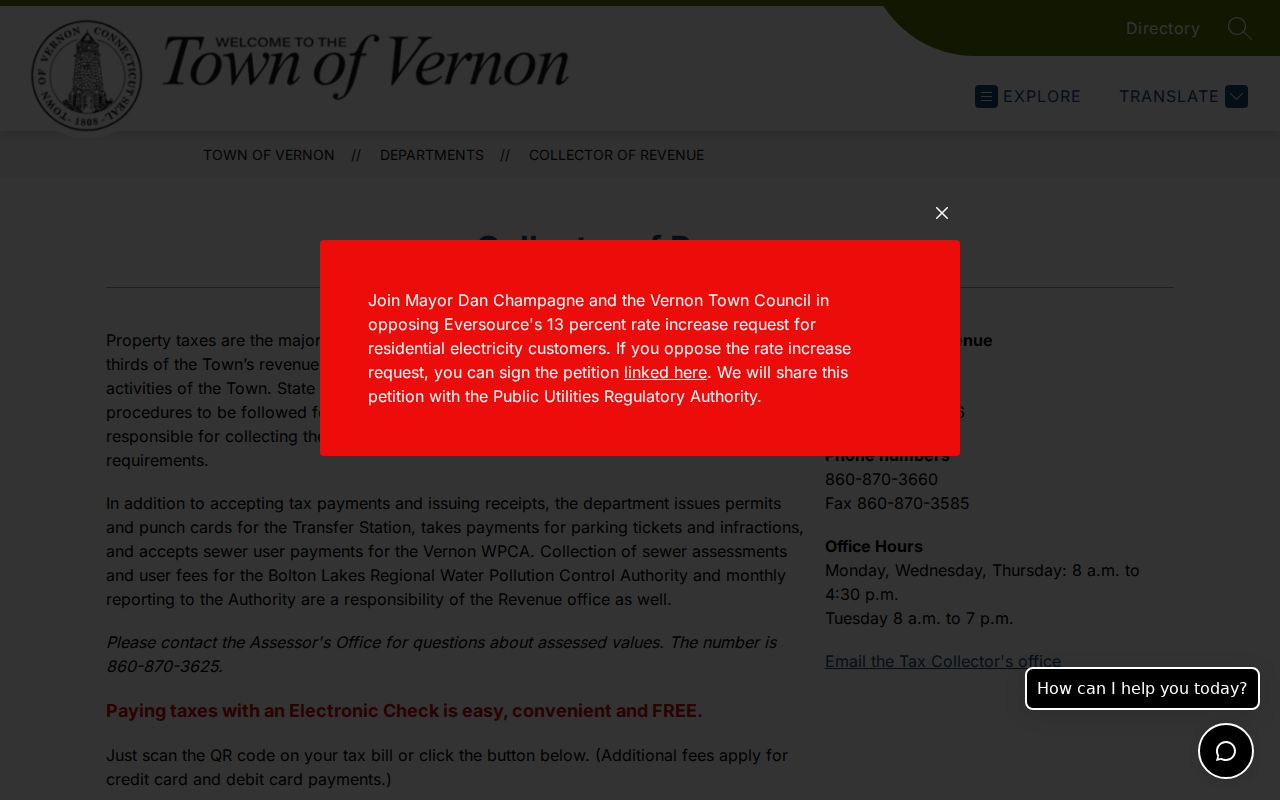
Its public-tax warning drives home a simple rule: treat the portal as a search aid, and treat the collector as the source for a complete payoff or account balance.
Revaluation Dates Shape Tolland County Property Tax Records
A revaluation resets the market-value base. But it does not set the tax bill by itself. Tolland finished a five-year revaluation for 2024. Its Vision database later reported a March 2026 update built on the 2025 Grand List. Mansfield reset values to October 1, 2024 after its townwide revaluation. Ellington mailed preliminary 2025 revaluation notices in November 2025 and held informal hearings in December. Billing on that list starts in 2026. Vernon adds a timely caution with its 2026 field inspections. The town says identified appraisal staff will inspect accessible exteriors through September. They will request interior access only with permission. A working card during data collection can therefore reflect a different stage. It may differ from the later certified roll. Wait for the certified version before treating interim numbers as final.
Note: Save the card's update date and valuation reason, since a revaluation notice, Grand List, and issued bill mark different stages.
Exemptions and PA 490 Alter the Tolland County Tax Base
Exemptions and use classifications belong to the assessor, not the collector. Connecticut covers veteran, disability, elderly, and other statutory relief. PA 490 can move qualifying farm, forest, or open-space land into use-value treatment. Each town assessor holds the eligibility rules, filing proof, and deadlines. A smaller taxable figure does not mean the town changed its market estimate. Read the exemption or use-class line beside the market and assessed totals. Some parcels carry several land uses. A detailed card may split the land lines. It can show use value separately. Ask for the official card if the public summary skips that detail.
Delinquent Tolland County Property Tax Records Need Confirmation
An unpaid bill, a lien, and a tax sale are three distinct states. Tolland's Collector of Revenue maintains delinquent billings, files and releases liens, and initiates tax sales. Vernon sometimes publishes a tax-sale property list. Mansfield notes that uncollected taxes can move to a suspense book yet remain collectible for up to 15 years from the original due date.
| Status | Record to read | Do not assume |
|---|---|---|
| Balance or interest | Collector account | That a lien or sale has begun |
| Tax lien | Collector file plus recorded lien and release | That an old portal balance remains due |
| Tax sale | Current official notice and property list | That a delinquent listing sets a sale date |
Ellington charges 1.5 percent per month on delinquent property tax once the 30-day grace period ends. Town rules and account facts control the outcome. Request a current payoff from the collector before trusting an online total.
When a Tolland County Tax Portal Falls Short
When a town's tax portal leaves you empty-handed, work down the municipal chain. The assessor counter holds the official property card. The collector counter, or a phone call, gives the full bill balance. Mail works for a documented payment or copy request. For records a town will not release freely, a focused Connecticut Freedom of Information Act request is the next step. No mandatory FOIA form exists. A town may offer one, though. Name the town. Include the parcel ID, the address, the tax year, and the exact record you want. Plain copies carry a price ceiling. Under C.G.S. §1-212, municipal plain-copy charges generally may not exceed $0.50 per page. Tax-payment convenience fees and statutory certified-copy charges sit outside that cap. Ask up front whether you will get inspection, an electronic copy, or a certified account statement.
Contest a Tolland County Assessment Through the Town Board
An assessment appeal belongs before the municipal Board of Assessment Appeals. It never goes to the Collector of Revenue. Begin at the assessor's office instead. Verify the parcel, the valuation date, the land and improvement totals, and the stated reason for the change, then obtain that town's current petition. Evidence helps, though what matters depends on the dispute: comparable sales, photographs, an independent appraisal, fresh measurements, deed facts, or clear proof of an error. Deadlines vary by town and by reassessment cycle. Vernon's page publishes a filing deadline and a March hearing process. Mansfield's 2026 appeal form asks for parcel and value details, the reason for appeal, supporting material, and a signature. A prior year's date should never be reused. Always check the current town notice first.
Appeal window. File the current town petition by the deadline stated for that Grand List. A collector cannot change the assessor's value after the window closes.
Mansfield's Payment Warning Adds a Practical Tax Check
Mansfield warned taxpayers in 2026 about payments left in unsecured home mailboxes. Some had been stolen or vandalized. The town steered residents toward its official online payment route, the post office, or counter hours instead. The notice doubles as a practical reminder. Confirm both the destination and the posted payment after any funds go out. Keep the confirmation number, canceled check, or stamped receipt with the bill. If the portal still shows a balance, contact the collector with the parcel account and payment evidence rather than mailing a second payment on the strength of a stale display.