
Deed Types in Tolland County Deed Records
Every deed type tells its own story. A recorded deed places a claimed transfer into the town's public land record. Its label helps explain the transaction. But warranty, probate, and foreclosure questions still need the full document.
| Deed Type | What It Does | Common Use |
|---|---|---|
| Warranty deed | Conveys the stated interest with deed warranties | Ordinary arm's-length transfers |
| Quitclaim deed | Conveys the interest the grantor has, if any | Family, trust, estate, or corrective changes |
| Fiduciary deed | Conveys through an executor, administrator, or trustee | Estate or trust administration |
| Foreclosure certificate or committee deed | Documents a court-directed title event | Foreclosure proceedings |
| Tax-sale instrument | Records a statutory tax process | Delinquent real-estate taxes |
The same index holds more than deeds. Mortgages, assignments, releases, judgment liens, mechanic's liens, easements, restrictions, and condominium declarations all appear beside them. They describe interests rather than convey them outright.
Town Clerks Keep Tolland County Deed Records
Connecticut dissolved county government in 1960. Land records therefore rest with the clerks of the county's 13 towns. A Mansfield deed sits in Mansfield's books. Vernon and Ellington keep theirs the same way. The historic Tolland courthouse runs no county land-record counter. Match the town to the parcel's municipal location. Ignore the postal label. Each clerk's own website is the best portal starting point, because Connecticut's older town-clerks platform and RECORDhub are shifting in stages. The statewide landing page lists participating towns, guest index options, accounts for image access, and $1-per-page image pricing. Even so, local coverage and counter practices still govern what you can reach.
Search Tolland County Deed Records in GovOS
The Tolland Town Clerk GovOS portal opens onto the Land Records department with Quick Search and Advanced Search. Those controls offer several routes into deed records.
| Control | Accepted clue | Search use |
|---|---|---|
| Search Term | Grantor, grantee, subdivision, document type, document number | Finds indexed parties or instruments |
| Date Range | From and to recorded dates | Narrows a known transfer period |
| Quick Date | 24 hours, 3 days, 1 or 2 weeks, 1, 3, or 6 months, 1 year | Checks recent filings |
| Index Only | Individual indexed terms | Tests structured entries |
| Index & Full Text | OCR phrase | Tests eligible document text |
| Card View | Result display | Shows added entry details |
The portal's public search page displays that entry point. Treat OCR as a supplement, since old print, handwriting, and scan quality can hide a match.
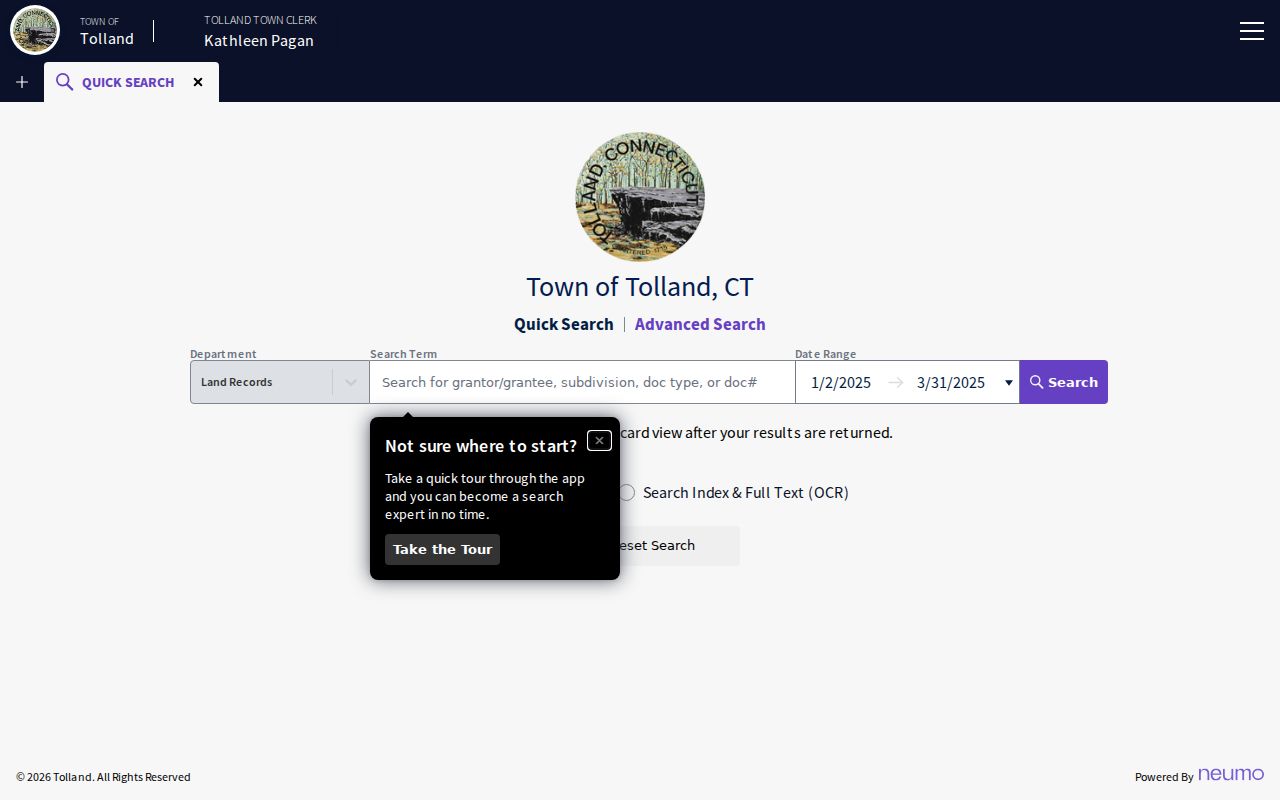
From a matching result, save the party roles, document type, recorded date, and number or book/page. Keep the legal or subdivision text too.
Follow Grantors in Tolland County Deed Records
A name index shows direction. The grantee takes the interest. The grantor conveys it. Start from the owner and transfer clue on the assessor card, confirm the newest deed, then follow its parties and references through the chain.
- Search the present owner as grantee near the card's latest transfer date.
- Open the match and compare the parcel description, consideration, and prior owner.
- Search that grantor as a grantee to locate the deed by which the grantor acquired the land.
- Repeat while recording every book/page, instrument, deed type, and date.
- Move to older index books or the town counter when modern portal coverage ends.
- Grantor
- The party conveying the stated interest.
- Grantee
- The party receiving the stated interest.
- Chain of title
- The linked sequence of instruments affecting ownership over time.
- Book/page or document number
- The clerk's citation used to retrieve a recorded instrument.
Names trip up searches in quiet ways. Search spouses separately, reverse name order, strip entity punctuation, and test trustee or estate language. Nominal consideration can mark a chain link. It need not be an open-market sale.
Tolland County Deed Records From 1715 to the Online Era
Tolland's land records illustrate ownership back to 1715. Public online coverage starts on February 25, 1942. The earlier centuries stay in older books and indexes. Recent documents, by contrast, can be searched remotely. The town's preservation program recently rebound grantor and grantee index books covering 1970 through 1983. It also re-shelved damaged general indexes and restored about 70 maps in Volume 5. When a cited volume is absent online or temporarily unavailable, ask the clerk whether conservation, indexing, or a separate map series explains the gap. Tolland County lost no deeds to a courthouse fire, so treat a missing result as a gap, not a catastrophe.
Mansfield Expands Tolland County Deed Records to 1702
Mansfield reports that all of its land records are online from 1702. That access comes in two forms. RECORDhub coverage begins at volume 122, dated May 19, 1973. Volumes 1 through 121 live in online index books instead. Proprietor's Records and Town Record Books 1 and 1A need their series codes. They also need a book-page search. PR1 covers the proprietor period from 1702 to 1730. RB1 and RB1A mark the early town volumes. Map indexes begin in 1913. Many maps from 1927 forward are online. A missing upload is a request for the clerk, not a break in title.
Note: Record the exact book series, page, portal route, and access date so a later platform migration does not erase the citation trail.
Vernon Tolland County Deed Records at the Counter
Vernon's 2023 property-fraud announcement drew a practical line. The public can inspect the land-record index online. Document images remain at the Town Clerk's office. So an index hit answers whether something was recorded under a name before it reveals what the instrument says. Use the public index to gather party names, date, type, and reference. Then request the image or read it at the counter. Compare the legal description and any cited prior instrument. Vernon's sample parcel card lists transfer rows with consideration, transfer date, deed type, and book/page, which makes the assessor card a launch point, not a deed substitute.
Claims and Releases in Tolland County Deed Records
A full land-record review reads past deeds. Mortgages, assignments and releases, mechanic's liens, judgment liens, municipal tax liens, easements, restrictions, declarations, condominium instruments, and foreclosure certificates can all touch the parcel. The later release or satisfaction is often its own record. So is a court judgment or termination. Search both current and former owner names. Follow every cross-reference you meet. A Superior Court docket may explain a foreclosure or lien enforcement, a Probate Court file may explain an executor deed, and the recorded land instrument remains the public title notice worth retrieving.
Name Alerts for New Mansfield and Vernon Filings
Mansfield runs a PropertyCheck alert service that works by email or text. Vernon offers a free alert too. Both watch for new filings under a name you register. Mansfield's own instructions say to enter several variants. Indexing can show initials, spacing, or other party forms that differ from the exact spelling you expect.
Treat any alert as a signal, nothing more. A match does not block the document. It does not verify identity. It will not catch every spelling on its own. Open the clerk's index and read the entry closely. Reach out to the clerk or a qualified professional quickly if the filing is unfamiliar.
Obtain a Tolland County Deed Records Copy
Begin at the town clerk portal. Pull the exact document number or book and page. If the site shows no image, request counter inspection, a plain copy by mail or electronic delivery, or a certified copy. Tolland charges $1 per page at the counter. It costs $2 per page to print or save an online image, and $2 to certify. Other towns and RECORDhub accounts may apply different image or statutory charges. Confirm the current amount with the clerk responsible.
Connecticut FOIA requires no statewide form. A written request simply needs the town, the parties, the record type, the date, and the citation. Ask for the underlying image, not just an index printout. For historical digging, add the book series. Also ask about older indexes, vault volumes, microfilm, maps, and anything temporarily out for preservation.
Recorded, not guaranteed. Tolland County deed records show what a town clerk accepted and indexed. They are not a title opinion, and a public search may miss unrecorded interests, indexing variants, or legal issues that require a qualified title professional.