
Separate the Numbers in a Tolland County Property Value Record
A Tolland County assessor card often stacks several figures on one parcel. Read them by meaning, source, and date. The assessed value answers one question. The appraised value answers another. The prior year's figure answers a third.
The deed records add a transaction figure, since every recorded deed carries its sale amount. Even that number can mislead. A deed may reflect a family transfer or a partial interest rather than an open-market sale. Treat it as one clue among many.
| Value type | Meaning | Official record |
|---|---|---|
| Market or appraised value | The town assessor's full-value estimate as of the applicable valuation date | Assessor card and Grand List work |
| Assessed value | The statutory tax-base figure, generally 70 percent of fair market value in Connecticut | Assessor card and Grand List |
| Land value | The assessor's value assigned to the site, sometimes split by use class | Detailed property card |
| Improvement value | The assessor's value assigned to buildings and taxable improvements | Detailed property card |
| Last sale or consideration | The amount indexed for a recorded transfer, which may be nominal or non-market | Town clerk deed and transfer row |
Connecticut's assessment ratio ties the assessed value to the market estimate. It is not a discount forecast. Exemptions and PA 490 use-value treatment can shift the taxable picture without moving what a willing buyer might actually pay for the property.
Vernon's Card Breaks Down Tolland County Property Value
Vernon's public parcel card works well as a local model. It separates market land, improvement, and total values from the 70-percent assessed or use-value columns. The card also lists several assessment years with reasons for change. So you can tell whether a number came from revaluation, maintenance, or another recorded event on the parcel. The transfer table adds consideration, transfer date, deed type, and book/page. Those fields let you compare a sale against the assessor's later value. They also keep transaction and valuation evidence distinct. One sample card shows entries from 2023, 1992, and an older legacy row. That mix is exactly why the newest transfer must be identified first. Reading an older deed amount as the current value would skew the whole comparison.
Note: Read the valuation year and reason for change beside every total; the largest number is not necessarily the newest or most relevant.
Look Up a Tolland County Property Value by Town
Tolland County has no county assessor. Each town keeps its own property records, so start by confirming the actual municipality. Tolland uses Vision, Mansfield uses AxisGIS, and Ellington publishes property-card and MapGeo routes. Vernon offers public parcel cards through its GIS. Watch the quirks: a Rockville mailing label still points to Vernon. Storrs and Mansfield Center addresses belong in Mansfield's system.
- Search the town's official assessor or GIS portal by the complete situs address, then try a partial address if needed.
- Select the matching parcel and copy its town-specific parcel, tax ID, or map-block-lot key.
- Open the property card and record the valuation year, market total, assessed total, and land and improvement splits.
- Check exemptions, use classifications, and the reason for change before comparing one year with another.
- Read the last-transfer row, then confirm the consideration and deed type in the responsible town clerk's index.
- Market value
- The assessor's full-value estimate for a stated valuation date.
- Assessed value
- The figure used as the tax base before applicable adjustments.
- Assessment ratio
- The relationship between assessed and full value; Connecticut generally uses 70 percent.
- Sale consideration
- The amount associated with a deed transfer, which may or may not reflect an arm's-length sale.
- Revaluation
- A townwide update of market estimates required on the municipal cycle.
Read Tolland's Current Property Value Card Carefully
The Tolland Vision parcel-card route gives a public example. It shows the town-level record that ties a parcel to its assessment details.
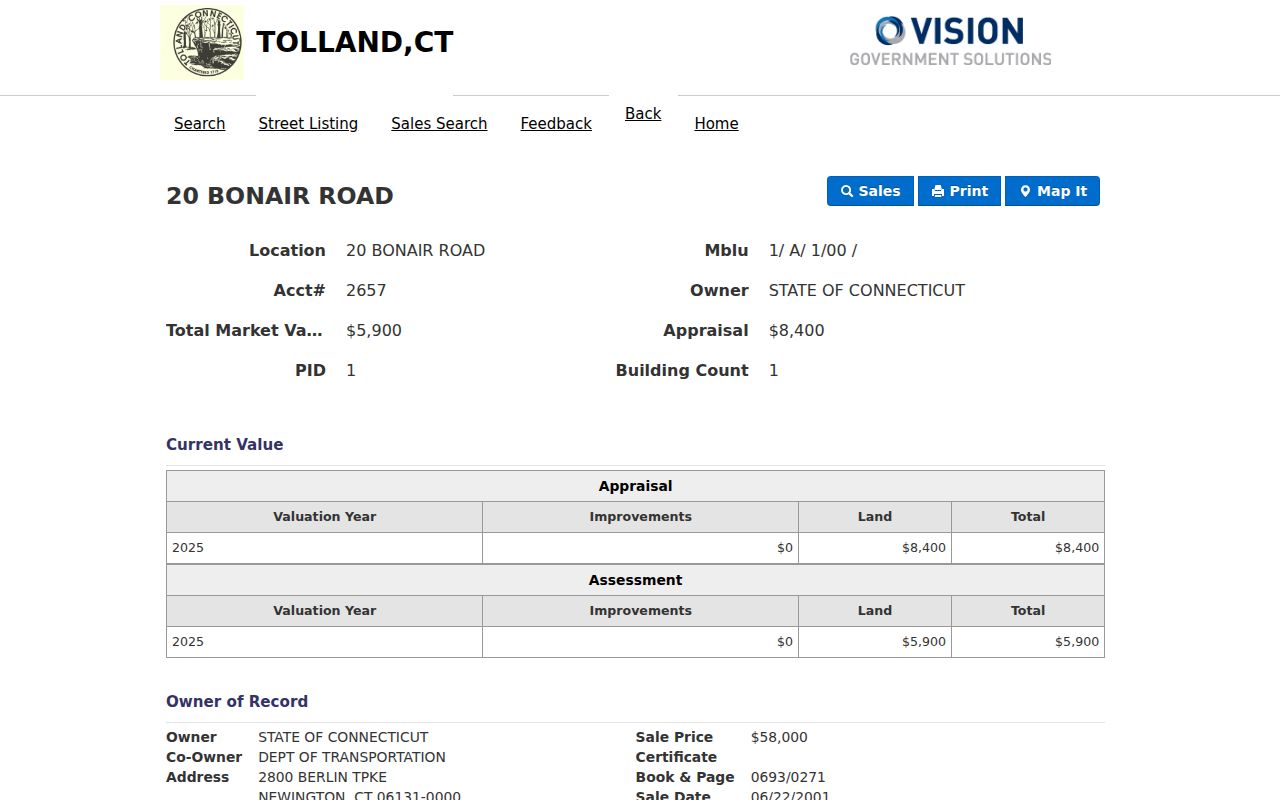
Dates control interpretation on these cards. Tolland's database reports an update in March 2026 using 2025 Grand List data. Record the portal update and the card's valuation year separately. Neither one makes the figure a live market estimate.
Revaluations Reset Tolland County Property Values
Tolland completed a five-year revaluation for 2024. Mansfield's AxisGIS notice says its current cards were reset to October 1, 2024 market values. That reset followed the townwide revaluation. Ellington mailed preliminary 2025 revaluation notices in November 2025. It held informal hearings in December. It used the 2025 Grand List for bills beginning in 2026. Vernon announced field inspections for its state-mandated 2026 revaluation, with work running through September. Staff carry identification and vests, inspect accessible exteriors, and request interior access only with permission. During that stretch, a public card can shift until the later list settles. A new assessment can rise while a tax bill moves differently. That happens because the mill rate is adopted separately. This page stops at interpreting recorded numbers. Current bills, exemptions, and appeal mechanics sit elsewhere. They belong in the Tolland County property tax records guide.
A Tolland County Sale Price Needs Deed Context
The assessor transfer row is only a lead. The town clerk's recorded deed is the primary source for the transfer itself. Search the grantee and grantor. Then note the recording date, deed type, consideration, and book/page or document number. The deed's date may not match the card's update date. A zero-dollar or low consideration can still be a vital ownership link. Family transfers and trust funding are common examples. Estate deeds, life-estate changes, corrective instruments, and some entity reorganizations also qualify. None are ordinary sales. An older arm's-length price, conversely, may say little about current condition or demand. Treat each price as one dated fact rather than an automatic present value.
PA 490 Can Change an Ellington Property Value View
Ellington's assessor materials link farmland and open-space classifications to Connecticut's PA 490 use-value rules. Those rules sit under C.G.S. §§12-107a through 12-107g. So a card or GIS theme may show land taxed at use value. That figure can fall far below a full development-market estimate. This matters around Crystal Lake, Hockanum, and the agricultural edges where land classes vary. Read each land line, exemption, and classification instead of comparing bottom totals. One parcel can mix dwelling land, excess acreage, and farm use. The assessor holds the official classification and application record. A GIS color alone cannot establish eligibility.
Three Dates Keep Tolland County Value Research Accurate
Keep three dates separate: assessment date, deed recording date, and portal update date. A newly recorded deed may appear before the assessor updates ownership or value. A revaluation notice may still be preliminary. But the certified Grand List and later bill mark later stages. These timing gaps explain most apparent conflicts. Neither office necessarily made an error.
| Date to save | What it anchors | Common mistake avoided |
|---|---|---|
| Valuation or Grand List date | The assessor's market and assessed totals | Calling an older mass-appraisal figure current |
| Recording or transfer date | The deed and its consideration | Matching price to the wrong assessment cycle |
| Portal update/access date | The version of the card reviewed | Assuming a later database refresh was already included |
Check the public card for its “as of” date. Without one, ask the town assessor for the official card under the Connecticut Freedom of Information Act. Keep the request narrow, naming only the town, the parcel ID, the address, and the valuation year you need.
Know What a Tolland County Assessor Value Cannot Prove
A Tolland County assessor relies on mass-appraisal methods. That means one formula values many parcels at once for municipal taxation. The number cannot reflect every detail of a single property. A private condition issue may escape the assessor's math. So may a recent repair, financing terms, or a buyer's particular tastes. Treat the figure as a tax value, nothing more. It is not a title opinion, a structural inspection, a zoning determination, or a boundary survey. It never claims to be.
Value is not price. A Tolland County assessed value is a tax-base figure, not a promise of what the property will sell for. Obtain a licensed appraisal for a present, property-specific market opinion.
Sometimes the number just looks wrong. Start by asking the assessor for the property record card behind the value. Ask for the current appeal instructions too. An online estimate or a deed price alone will not change anything official. Only the town assessor and the Board of Assessment Appeals control the municipal process. They are the ones who correct a valuation.